The minimally invasive approach uses a smaller surgical access point compared with conventional open procedures.
Smaller surgical access and limited tissue disruption may help minimize blood loss during selected procedures.
The technique aims to preserve surrounding muscles and healthy tissues as much as possible.
Smaller incisions and reduced muscle disruption may contribute to less post-operative discomfort in suitable patients.
Depending on the procedure and individual recovery, some patients may be able to start walking soon after surgery.
Suitable patients may experience a quicker return to routine activities compared with more extensive surgical approaches.
Every patient’s condition and recovery is different. Your surgeon will determine the most appropriate treatment based on your diagnosis.
Discuss your symptoms and medical history with the specialist.
Clinical examination and relevant imaging, such as MRI, are evaluated.
Treatment is recommended according to your individual condition.
Suitable patients may be considered for an endoscopic invasive surgical approach.
Post-operative recovery and mobility are guided according to your condition.
Regular follow-up supports recovery and a safe return to routine activities.
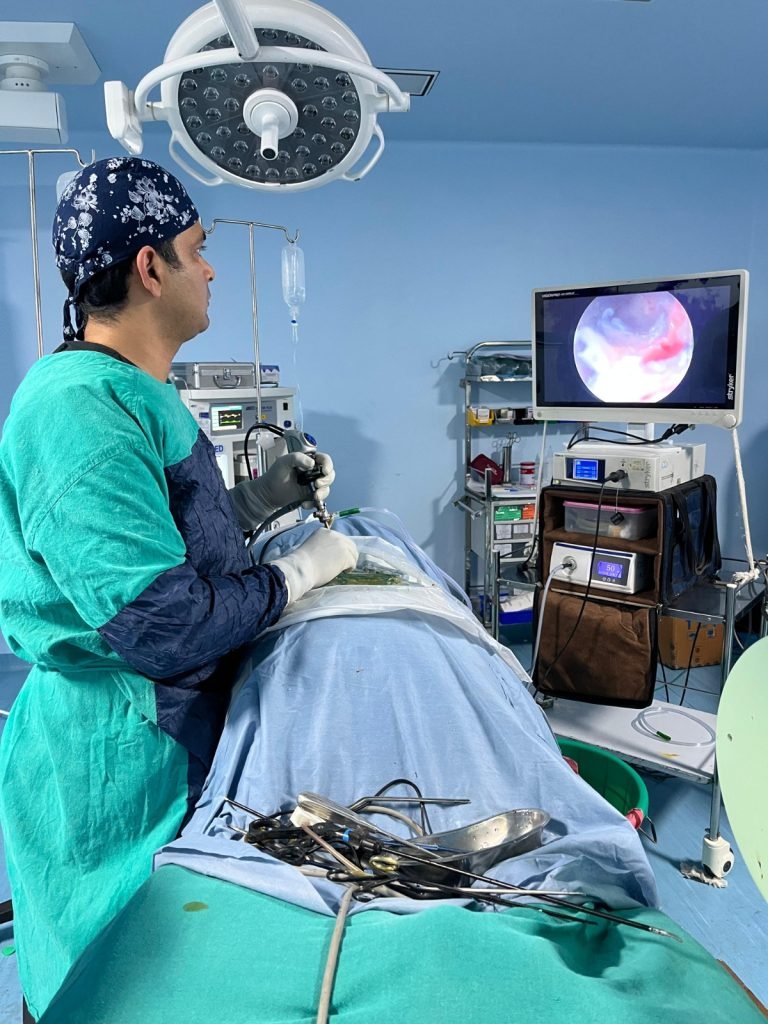
It is a minimally invasive spine surgery technique in which specialized endoscopic instruments and a camera are used to access and treat selected spinal conditions through a small incision.
It is our patient-friendly way of explaining Endoscopic Spine Surgery. The term highlights the minimally invasive nature of the procedure and the small incision/dressing that may be required in suitable procedures.
Patients receive appropriate anesthesia during surgery. Because the approach involves smaller incisions and less tissue disruption, some patients may experience less post-operative pain compared with more extensive open procedures. Individual experiences vary.
The minimally invasive approach generally aims to minimize tissue disruption and blood loss, although the amount can vary depending on the procedure and individual case.
Some patients may be able to walk soon after surgery or by the next day. However, this depends entirely on the type of surgery, medical condition, and individual recovery.
Recovery varies from patient to patient and depends on the condition being treated, type of surgery, age, overall health, and adherence to post-operative instructions.
No. Many cases can be managed without surgery. Surgery is considered based on symptoms, neurological findings, imaging, and response to conservative treatment.
Only a detailed consultation and evaluation of your clinical condition and imaging can determine whether Endoscopic Spine Surgery is appropriate for you.
Vardhman Neurospine Hospital —
Advanced Centre for Brain & Spine,
providing world-class endoscopic spine
care with compassion and expertise!
Contact: 7942686727
Email: drvardan@gmail.com
Address: Vardhman Hospital,Model Town,Karnal,Haryana-132001